Running clean
Air moves out of the grille and the room actually warms. No ice forming on the coil outside, no panel left open for a look inside, because there's nothing behind it that needs checking yet.
A mini split that won't turn on in cold weather is usually stuck in defrost, frozen up, or shut down by its own safety controls. Connecticut winters push outdoor temperatures low enough that the outdoor unit's coil can ice over as it pulls heat from the air. The unit is supposed to pause and run a defrost cycle to melt that ice, then go back to heating. If the coil iced over badly before it caught the problem, or if the defrost sensor or control board isn't doing its job, the system can shut itself off instead of restarting. Low refrigerant makes the icing worse and more frequent. A tripped breaker or a blown fuse from the strain of constant cold weather operation will also leave it dead with no error shown at all. None of this means the unit is ruined. It means something specific stopped it, and that part needs to be found before the heat comes back on.




The outdoor unit isn't broken just because it goes quiet in the cold. It's built to pause itself. When the coil picks up ice from pulling heat out of freezing air, the control board switches the system briefly into cooling mode to melt that ice off, then switches back. The thermistor on the coil is what tells the board ice has built up enough to start that process. While it runs, the indoor blower usually stops or slows down, since nobody wants cold air blowing into the room during a defrost cycle, and that's often the moment someone assumes the whole unit died. Check the remote or the wall control first. A snowflake icon or a blinking light usually means defrost, not failure. The trouble starts when that cycle doesn't end. A dirty outdoor coil, a defrost sensor giving bad readings, or a reversing valve that's stuck can leave the unit defrosting over and over without ever getting back to heating. And on the coldest nights, some units are designed to lock out heating mode entirely until temperatures climb back up or the system gets reset by hand.


A mini split that cuts out in January doesn't fail quietly. You'll feel it first in whichever room that head serves, the air going from warm to room-temperature while the outdoor unit sits there in defrost or trips its own safety switch. If that room is where you spend the evening, you notice fast. Left alone, the problem tends to get worse, not better. Ice on the outdoor coil puts weight and cold stress on fins that are thin enough to bend by hand, and once they're bent, airflow across the coil drops and the unit struggles even after the ice is gone. A system that keeps shutting off on its own protection will often keep trying anyway, drawing power each time it cycles back on without ever warming the room, and Connecticut's electric rates make that an expensive way to stay cold. If this mini split is the main heat for a bedroom, a home office, or an addition rather than a supplement to a furnace, a shutdown on a cold night isn't a comfort issue, it's a backup-heat issue, and space heaters aren't built to run all night unattended. The part that costs the most to ignore is the compressor. It's the most expensive component in the system, and running a unit that's icing up or short-cycling puts strain on it every time it fires. A problem that starts as a stuck defrost cycle in December can turn into a compressor replacement by March if it runs that way long enough.


A mini split that keeps dropping out of heat on a cold night isn't something to keep resetting and hoping it holds. Every reset that fails costs you heat in the room you're trying to warm, and in a state where power rates run as high as Connecticut's, a unit cycling on safety lockouts or stuck in defrost is working against you, not for you. The outdoor coil, the defrost board, the sensors that decide when to switch modes: any one of those can be the reason, and sorting out which one takes someone who works on these systems through a Connecticut winter and knows which part tends to fail first. A local, licensed contractor matched to your situation can look at your specific unit instead of guessing from a general list of causes. One contractor means one visit to get the actual answer, not a string of calls while your living room stays cold.
Heat pumps pull heat out of outdoor air, and the colder that air gets, the harder the system works to find any. Below a certain outdoor temperature, most mini splits lean on a backup heat strip or hold a minimum compressor speed just to keep from icing over faster than the defrost cycle can clear. A hard freeze in January asks more of the unit than a mild stretch in November does. If yours only quits on the coldest nights, that's not a coincidence. It's the outdoor unit hitting the point where it can't keep the coil clear and keep heating the room at the same time.
Mini splits carry sensors that cut the system off rather than let it run in a state that could damage the compressor or the coil. A pressure switch, a temperature sensor on the coil, or a float switch on the drain pan can all trigger a shutdown, and each one is reading something different. That's why two units that won't turn on can have two different problems underneath. The control board logs which sensor tripped, which is information a contractor can read directly instead of guessing. Resetting the breaker clears the code but not the cause, so the same sensor trips again the next time the outdoor temperature drops.
At 29.31 cents per kilowatt-hour, a mini split stuck cycling on backup heat strip runs up your bill fast. A unit that keeps resetting instead of heating properly is pulling that backup power every time it tries, so a short-cycling problem costs more here than almost anywhere else.
EIA-861 2025 statewide residential average

Air moves out of the grille and the room actually warms. No ice forming on the coil outside, no panel left open for a look inside, because there's nothing behind it that needs checking yet.

Dust and grime like this on the casing usually sit on the filter and coil behind it too. That buildup blocks airflow, and blocked airflow is one more way a mini split ends up icing over or shutting itself down on a cold night.



Connecticut summers run humid, and the dew point averages 61°F across June, July and August, according to NOAA climate data. That's the number that tells you how heavy the air feels on top of the heat. Your mini split isn't just cooling the room, it's pulling that moisture out of the air to do it, which means the compressor and coil run harder and longer through those months than a dry-climate unit ever would. Come winter, that's the same coil and the same compressor you're relying on to pull heat out of cold outdoor air. A system that worked hard all summer wringing out humidity carries that wear into the season when it has to switch jobs entirely.
NASA POWER T2MDEW county cells weighted by homes
You're checking the thermostat more than once, and the room still isn't warming. The indoor head might be running but only pushing out air that feels barely warm, or not room temperature at all. Sometimes the outdoor unit sits there quiet while a light blinks on the indoor head, no error you can read, just a dead stop. If you've gone out and looked at the outdoor unit, there may be a layer of ice across the coil or the bottom where it should be bare metal. Meanwhile the room you're heating is losing ground, and if this is the only source of heat in that part of the house, a few hours of this on a cold night is enough to leave the space noticeably cold by morning.
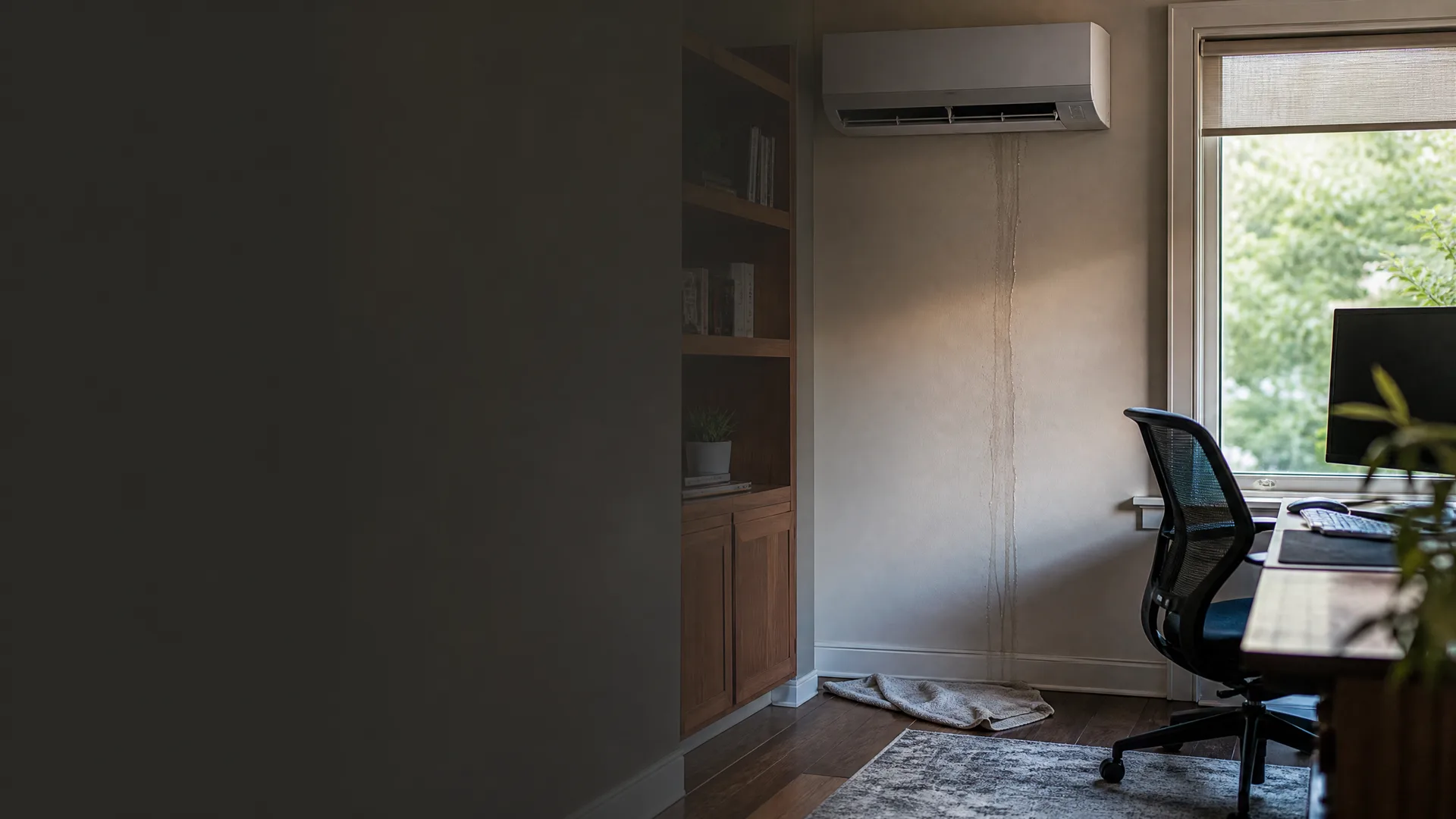
It's late afternoon in July and you're at the desk in your home office, the mini split on the wall humming like always. You notice the wall under it first, a dark streak running down from the unit, the paint gone damp and soft looking. By the time you get up to check it, water has beaded along the bottom edge of the indoor head and started dripping onto the floor. You grab a towel and lay it down, then stand there watching another drop form and fall. The room still feels cool from the air it's pushing out. Outside, the afternoon is thick and still, the kind of July day Connecticut gets most years.

Stuck in defrost, iced over, or shut down by a safety control. One of those three is what's keeping your mini split from heating the room right now, and none of them clears itself by resetting the unit again. Connecticut winters will keep testing it as long as it's left alone.
A contractor who works on mini splits all winter in this state has seen this exact failure plenty of times before. You'll be matched with one licensed and local, someone who already knows what tends to go wrong in a cold snap and how to check it fast, and that one contractor will reach out to you directly. Not a handful of companies competing for your callback, just the one who's right for what your system needs.

The pro who reaches out is licensed in Connecticut.