






What defrost mode means on a Connecticut mini split

A white wall-mounted mini-split air conditioner indoor unit centered against a plain light gray background.
Find my pro

Why is my mini split blowing cold air and showing defrost mode?

Cold air coming out while the display shows defrost mode usually means the system paused heating on purpose, and with Connecticut winters pushing the outdoor unit hard, that cycle can hit several times a day. It feels like a breakdown at the worst moment, when the house needs heat the most, but the system is following its own programming.

It's melting the frost off the outdoor coil, not malfunctioning

Cold Connecticut air holds moisture, and that moisture turns to frost on the outdoor coil whenever the unit is running heat below freezing. Defrost mode reverses the cycle for a few minutes so the coil can shed that frost. While it runs, the indoor head blows cold or room-temperature air since the system is pulling heat from inside to warm the outdoor coil. It should end on its own and switch back to warm air. If it runs long, repeats constantly through the day, or the indoor air never warms back up after, something in that cycle isn't working right and the unit needs a look.

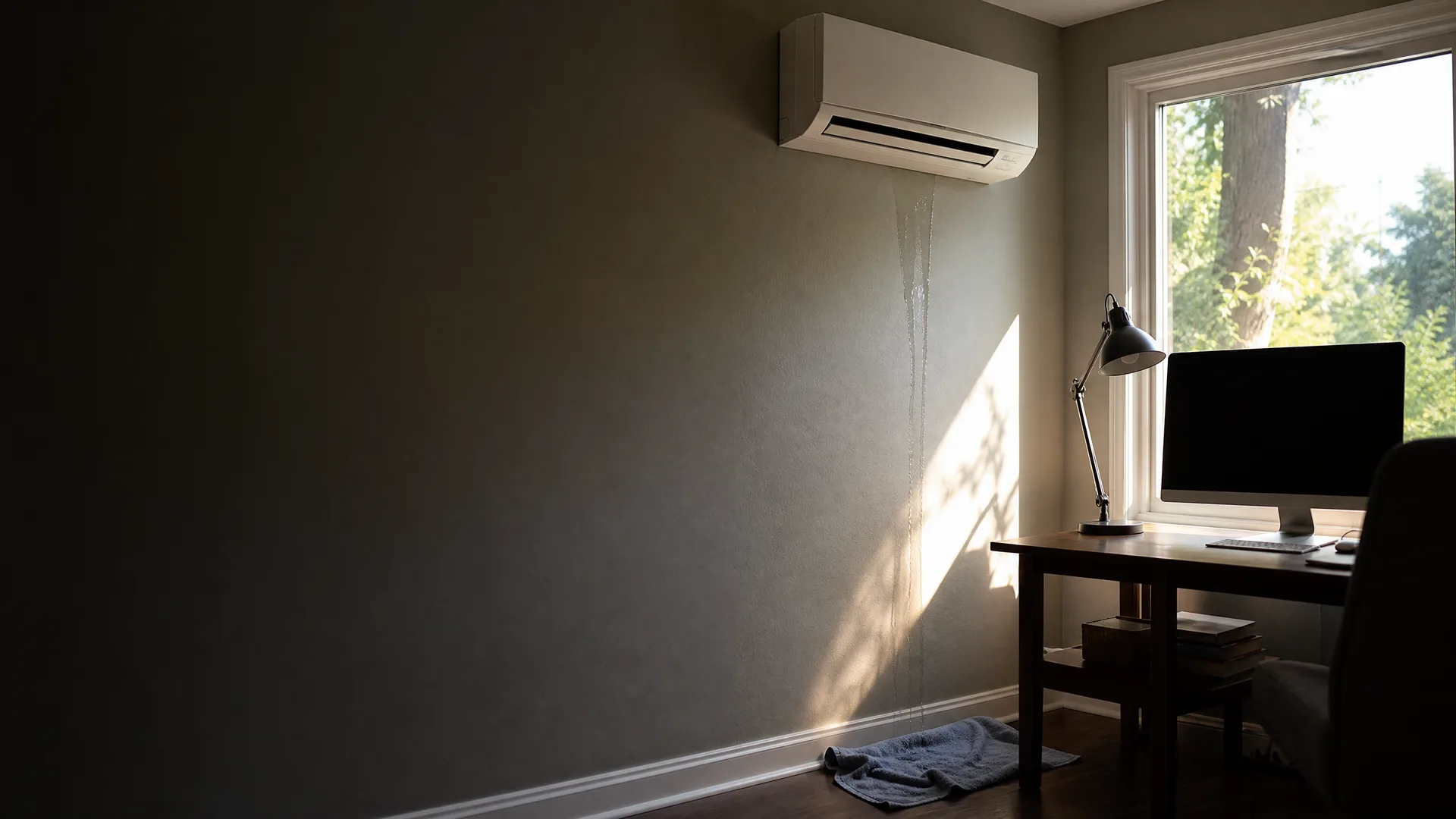
A wall-mounted mini-split air conditioner leaking water down a dim gray wall onto a towel on the floor, beside a window with a desk, lamp and monitor.

You're at your desk on a July afternoon, the kind where the air outside sits thick and still. The mini split above the window has been running since morning. You look up from your laptop and notice the wall under the indoor unit is wet, a dark streak running down toward the baseboard. You get up, put a towel down on the floor where the drip has started pooling, and stand there for a second watching the unit. It's not blowing warm or showing any defrost light. It's just leaking, right there in the middle of a humid afternoon, while you're trying to get work done and keep the house livable for whoever else is home.

Is this normal, or is my mini split struggling

Watch the outdoor unit for a few minutes. If the fan has stopped and you see steam or water coming off the coil, that's the system clearing frost before it goes back to heating, and it should return to warm air within half an hour. If instead the indoor unit keeps blowing cold air for longer than that, or the cycle repeats every hour through a cold night, the system isn't recovering the way it should. You might also notice the room never quite reaches the temperature you set, or the outdoor unit stays caked in ice even after a defrost cycle finishes. Left alone through a Connecticut winter, a unit stuck in repeated defrost runs harder for less heat, and that shows up on your electric bill before anything else.

A woman with long blonde hair in a light blue shirt leans back on a beige sofa with her eyes closed, in a softly lit living room with cushions and a blurred plant and shelf in the background.
A woman with long dark hair in a gray knit sweater sits on a gray sofa with a cushion, looking toward a window in a living room with framed pictures and a lamp in the background.
A woman with long dark hair in a light grey knit sweater sits on a sofa indoors, looking to her right, with a framed landscape picture, a potted plant and a curtained window behind her.
A woman with long dark hair leans back against a gray sofa with her eyes closed, in a living room with a curtained window, a potted plant, and a dark screen in the background.

A local pro for your mini split repair

A mini split that keeps dropping into defrost mode during a cold snap is working the way it's built to work, but if it's happening every hour, or the room never gets warm again after, something is off. It might be a low refrigerant charge, a defrost sensor that's reading wrong, or a reversing valve that's stuck. None of those clear themselves, and running a system that's losing the fight against ice all winter costs more on a power bill that's already among the highest in the country. You don't have to track down who works on mini splits in your part of Connecticut and call around. Send the request and a contractor who handles this equipment will reach out to you about it, and from there it's off your plate.

The outdoor coil has to reverse the cycle to melt that frost, pulling heat from inside the house for a few minutes to do it. That's the cold air you feel.

A normal defrost cycle runs about 5 to 10 minutes, once every hour or so when it's cold enough outside to need it. If yours runs longer or more often than that, the unit is working harder than it should to stay ahead of the frost.

A smiling older woman with gray shoulder-length hair in a cream cable-knit turtleneck sweater stands behind a wooden board holding a round loaf of bread, in a warmly lit kitchen with a dark window and shelves behind her.
A woman and a child wrapped together in a thick knitted blanket on a sofa, both with eyes closed, with a lit table lamp and houseplant in the dim background.

Defrost cycle running as it should

The outdoor unit stops its fan, frost melts off the coil, and warm air comes back inside within 5 to 10 minutes. This happens once an hour or so during a cold snap, more if there's damp air or snow blowing around the unit outside. You'll see steam or water dripping off the coil while it works. The indoor unit may blow cool or neutral air for a few minutes during this, then switch back to heat. If that's the pattern, the system is doing what it was built to do, and Connecticut winters ask a lot of it.
Defrost cycle stuck or too frequent

If defrost mode kicks in every 20 or 30 minutes, or the room stays cold once it switches back to heat, something is off. A low refrigerant charge, an iced-over coil that won't clear, or a bad defrost sensor can all cause this. The outdoor unit might look heavier with ice than usual, or the fan might not restart cleanly. This isn't the unit pausing to protect itself, it's the unit struggling to get through a cycle it should be able to handle on its own.

Power costs 29.31 cents per kilowatt-hour statewide

At 29.31 cents per kilowatt-hour, every defrost cycle your mini split runs is worth watching. A unit stuck defrosting too often is drawing power to fight frost instead of heating your home, and on a Connecticut electric bill that difference shows up fast.

EIA-861 2025 statewide residential average

A mini split dropping into defrost mode for a few minutes every hour during a cold snap is doing what it was built to do. Warm air comes back once the coil clears. What isn't normal is defrost that runs long, repeats every few minutes, or ends without the room warming back up. That points to something mechanical, a sensor reading wrong or a refrigerant charge that's low, and no amount of waiting fixes it. At 29.31 cents per kilowatt-hour, a unit stuck cycling like that is costing you while it keeps the house cold. You don't have to track down who handles mini splits in your part of Connecticut or sit on hold working out what's wrong. Send the details once and that search is off your plate. A contractor who knows these systems will reach out, look at what your unit is actually doing, and tell you whether it needs a part, a recharge, or nothing at all. The house gets warm again, and the worrying about it stops being something you have to carry.

A dimly lit room with a dark gray wall holding a white wall-mounted mini-split air conditioner near the ceiling, with a sofa, table lamp, potted plant, and curtained window at left.

Get the right pro for your mini split

Send the request today and let a mini split pro reach out to you.

Step 1 of 3: Equipment