Running clean
A mini split that's clear around the vents and intake pulls air through without a fight. It can read the room's temperature correctly and hold the setting you picked, which matters most on the coldest nights of a Connecticut winter.

A Connecticut winter can run from the first frost in November into cold snaps in March, and a mini split left on the wrong setting either struggles to keep up or burns through power doing more work than it needs to. You want a number that keeps the room warm without running the outdoor unit ragged on the coldest nights.
A mini split heats most efficiently when it holds a steady temperature instead of climbing back up from a cold start. Setting it to 68 or 70 and leaving it alone all day costs less than letting the room drop to 60 and asking the unit to recover ten degrees when you get home. The compressor works hardest on that recovery, and on a night in the teens or single digits, which Connecticut gets most winters, that extra load shows up on the power bill. Some units add a backup heat strip for those coldest stretches, and that strip is what pushes the bill up, not the compressor itself.





A mini split that's clear around the vents and intake pulls air through without a fight. It can read the room's temperature correctly and hold the setting you picked, which matters most on the coldest nights of a Connecticut winter.

Dust packed into the intake grille and vents forces the unit to run longer to push out the same heat. That extra runtime shows up on the power bill, and it's the kind of strain that wears a unit down well before its time.

Leave a mini split guessing through a Connecticut winter and it shows up on the bill before it shows up anywhere else. Power here already runs among the highest rates in the country, so a unit that's cycling on and off, or straining to climb back up from 62 to 68 every few hours, is spending more to do less. Set the right temperature and leave it there and the system settles into steady, efficient runs instead of repeated hard starts.
There's a comfort cost too. A unit set wrong doesn't fail outright, it just quietly underperforms, blowing lukewarm air on the coldest nights or running nonstop without the room ever feeling warm. If that sounds like what's happening in your house, it may not be the setting at all. It could be a filter, a sensor, or something in the outdoor unit that needs a trained eye. Answering a few questions about what your mini split is doing gets you matched with a contractor who can look at your specific system and take that question off your hands.

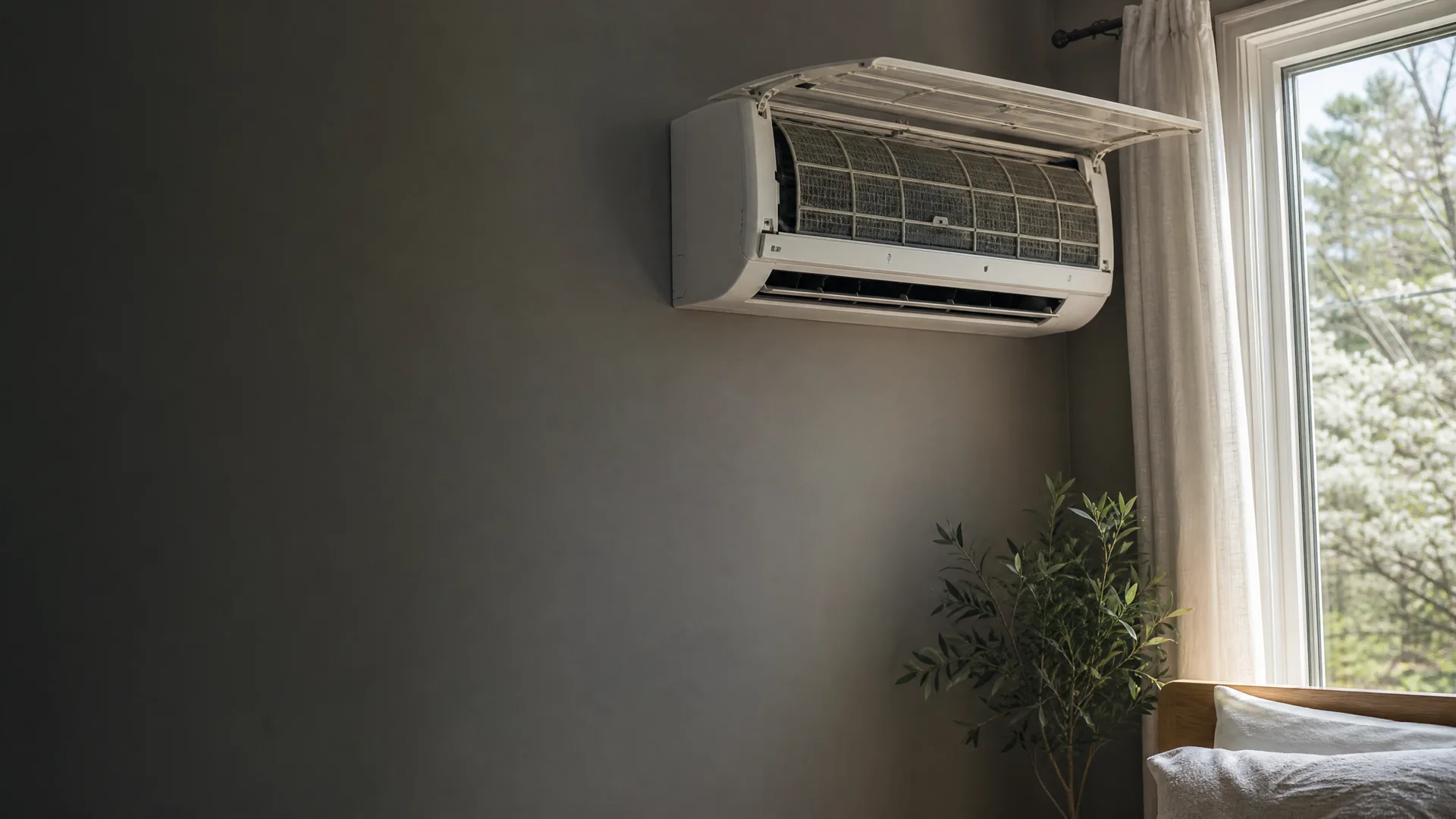
Spring sun comes in low across the bedroom carpet. You've got the cover off the mini split, looking at the filter screen you should have pulled out months ago. It's grey with dust, matted enough that you can't see through it. You think back to January, to the nights it ran and ran and never quite got the room past 65 no matter what you set it to. You hold the screen up to the window light. Behind you, on the nightstand, is the number for someone who can come look at the rest of it, the coil, the drain line, whatever else has been sitting through a winter of work.
The right setting only gets you so far if the unit underneath it is working harder than it should. A mini split that's never been serviced loses the filter and coil condition that make a steady 68 actually efficient, and no thermostat setting fixes a dirty coil or a low refrigerant charge. By the time you notice it on the bill, the unit's already been losing ground for weeks, maybe since the start of winter. A tune-up before the cold really sets in, or even in the middle of it, catches what a setting alone can't: a coil that needs cleaning, a filter that's choking airflow, a sensor reading the room wrong. Connecticut winters don't let up until March, and power here costs enough that a unit running inefficiently for that long adds up fast. Getting a contractor out to look at it means one less thing to track down yourself this winter, and one less reason to watch the bill with dread.
A mini split works hardest in the minutes right after it starts moving heat, while the compressor ramps up to meet the gap between room temperature and the setting. Leave the setting alone and it settles into a low, steady output that just replaces the heat the house loses. Change the setting every few hours and the compressor keeps ramping up again, which is the part that uses the most power. Picking 68 once and leaving it costs less than hitting 65 at night and 72 in the morning, even though the second pattern feels like it's saving something.
Mini splits are rated for a minimum outdoor temperature where they still produce useful heat, and most residential units are built to keep working well below anything Connecticut sees most winters. Below that point, output drops and backup heat strips, if the unit has them, take over, which is where the power use climbs fast. A unit set to 68 and left there rarely asks for backup heat except on the coldest nights of January and February. One set too low, then pushed up hard to recover, leans on backup heat more often than it needs to.


A mini split pulls heat out of outside air by running refrigerant through the outdoor coil, and on a cold, damp Connecticut day that coil picks up frost the same way a car windshield does overnight. The unit senses this on its own and runs a defrost cycle, reversing briefly to send warm refrigerant through the outdoor coil and melt the ice off. You don't set this, and you can't turn it off. While it's happening, the outdoor fan shuts down and the indoor unit can blow air that feels cool for a minute or two. That's the cycle doing its job, not a fault.
Where the setting matters is around the edges of defrost. A clogged indoor coil makes the compressor run longer to recover the room temperature it lost during the cycle, and that extra runtime is what shows up on the bill. The space under and around the outdoor unit matters too. Meltwater has to drain away from the coil, and if snow or mulch is packed against the base, that water sits and refreezes, which thickens the ice the next cycle has to clear.
Fan speed plays into recovery as well. A unit set to auto can push more air the moment defrost ends and the compressor starts rebuilding heat, where a fixed low speed holds it back right when it needs to move the most air.


Thermostat calls for heat when room temperature drops below your setting.
Outdoor unit pulls heat from the outside air, even in the cold.
Refrigerant carries that heat inside to the indoor coil.
Indoor fan pushes heated air out through the vents.
At 29.31 cents per kilowatt-hour, every degree your mini split works to make up costs more here than almost anywhere else. A setting that holds steady instead of swinging up and down keeps that cost from compounding all winter.
EIA-861 2025 statewide residential average



That same summer air that sits at a 61°F dew point across Connecticut, averaged over where homes here actually are, is what your mini split is clearing out from June through August. Come winter, the unit's doing the opposite job, pulling what little warmth there is out of cold outside air instead of pulling moisture out of thick air. The coil and fan that worked all summer against that stickiness are the same parts carrying the heat load now. If they came through summer caked with dust or lint, that buildup doesn't go away on its own, it just sits there making the unit work harder to hit whatever setting you've got it on. Source: NOAA regional climate data.
NASA POWER T2MDEW county cells weighted by homes
A steady 68 in heat mode gets you through a Connecticut winter better than chasing the thermostat up and down, and keeping the filter and coil clean is what lets that setting actually hold. That's the whole answer. The part that's harder to do yourself is knowing whether your unit is still clean enough inside to make good on it, and that's not something you can tell by looking at the vent cover. Once you send a maintenance request, you're done hunting for someone to check it. The search, the phone calls, the waiting on hold, that part stops being yours to carry. A contractor who works on mini splits in Connecticut homes gets your information and reaches out to you directly. You go back to your day knowing it's handled, with the coldest part of winter still ahead of you and one less thing sitting on your list.

No fee to send it, and nothing to sign.
A mini split working to catch up on a cold January night pulls more power than one left to hold a steady setting. Getting it looked at before the next cold snap means one less thing to think about when the temperature drops.